

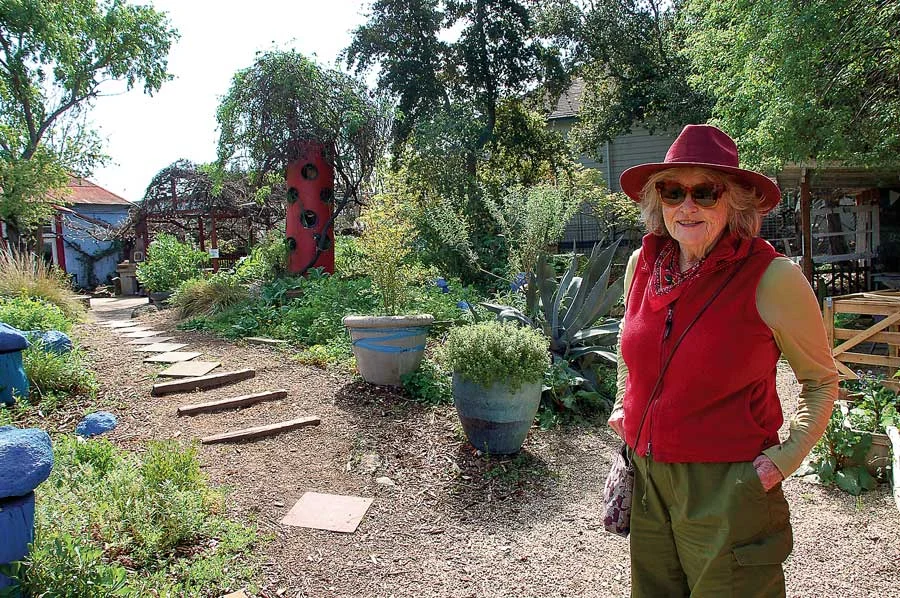
Alrie Middlebrook pauses for a moment between the rows of verdant crops at Hester Farm. The midmorning sun shines brilliantly on this flourishing plot where she’s been leading a visitor along an exploration of botanic gastronomy. After waiting for her guest to finish chewing on yet another leafy sample, she prods, “See how bitter?” Then she declares, “Bitter is good. I always say, ‘Lean toward bitter.””
When asked to explain the virtue of bitterness, she responds, “That is a wild taste. Americans have a really lazy palate. We like sweet, we like watery. We’re not accustomed to the wild flavors of nature.”
Such flavors abound at Hester Farm, a prolific gardening project located at 1440 The Alameda, just one mile west of Downtown San Jose. Wedged between an apartment complex and a soccer field, it supports some 75 plant selections on a tenth of an acre, roughly 4,200 square feet. Most of what grows there can be eaten, making it an excellent destination to find culinary inspiration.
In summer you’ll find an array of tomatoes (such as Sungold, Roma, Pear and Green Zebra) along with squash (Butternut, Spaghetti, Delicata and Chayote), plus plenty of other fruits including loquats, elderberries and Santa Rosa plums. You should still be able to catch the blooms on flowering herbs like yarrow, nasturtium or pearly everlasting (one of Middlebrook’s favorites). Try to acquaint yourself with some less-familiar varietals-maybe yampah, rue or lemonade berry. And if you pay close attention, you might spy a hummingbird zipping through the air or a lizard skittering across the ground.
But back to those flavors! Pinch off a piece of quailbush for a salty surprise, a hunk of French sorrel for a tangy citrus burst or a sprig of pineapple sage for a whiff of the tropics. Each newly pilfered morsel offers a layered gustatory revelation, the initial impression on the tongue often yielding to a secondary sensation as the crush of molars releases cytoplasmic magic. Underneath these waves of taste sits that faint earthiness accompanying any freshly picked outdoor plant, while beguiling textures add yet another dimension of enjoyment.
As mouthwatering as this cornucopia may be, it holds much more value than simply appeasing our appetites. Middlebrook views it as a solution to pervasive problems.

“We’ve been very wasteful, and not practical, and not economical, and certainly not sustainable in how we’ve created a food system,” she says. Hester Farm demonstrates a better path forward: striving to sequester carbon dioxide, conserve resources and restore habitat. It represents “an experimental farm,” where Middlebrook says the mind-set has always been “let’s try this, let’s try that.”
Maintained by community volunteers, college interns and high school students, it operates under the auspices of the California Native Garden Foundation (CNGF). Middlebrook helped launch CNGF nearly two decades ago, and served as its executive director until last year, when she retired from the post at age 80. Working with the nonprofit organization and on her own as a landscape designer, she became increasingly fixated on regenerative organic agriculture, a holistic approach that revolves around nurturing the soil. She remains eager as ever to sing the praises of this strategy.
“The thing about these food plants is, they are so pungent because the soil is so good,” she says about the edible beauties at Hester Farm. “When you grow things using regenerative methods, every year you’re adding compost, and you’re not disturbing the soil that much. Microbes don’t like to be bothered.” Left alone to thrive, these assorted bacteria, fungi, algae and protozoa boost nutrient availability through the productive churn of a microbiome, eliminating the need for fertilizer.
Microbiomes are of keen interest to Middlebrook, who considers them vital not just for enriching the soil but also for aiding our digestion and supporting broader ecosystems. She strives to keep these microscopic communities robust and functional—in the dirt, in our bodies and in the environment at large—by bolstering biodiversity on a macroscopic level. “I think it’s all connected,” she says.
Using Hester Farm as a model, she has developed recommendations for biodiverse crop choices suited to the Bay Area’s Mediterranean climate. She prioritizes native edible plants historically consumed by indigenous populations, as well as perennials that can supply harvests year after year. Drought-tolerant plants or those able to fix nitrogen also earn her approval, as do any with high levels of nutrients. Recognizing our nostalgic affinity for conventional fruits and vegetables that have come to dominate markets due to industrial production, she concedes the necessity of making room for what she calls “comfort foods.”
She hopes that her recommendations and the paradigm of Hester Farm will catch on more broadly. To some extent, they already have — she and her collaborators have sown their vision all across Silicon Valley. The most prominent example stands a half mile to the south at 76 Race Street, where CNGF manages an even larger plot, but over her career Middlebrook has had a hand in a thousand landscaping projects of some ecological benefit. And she doesn’t sound like she plans on stopping any time soon.
“I think the most important thing that I can contribute is mentoring young people and designing complex, biodiverse native gardens,” she says, reflecting on the road ahead. She believes that furnishing these kinds of spaces for city dwellers to gather, grow food and learn from each other will be critical in responding to both the threat of global climate change and the local affordability crisis. As she proclaims, “You start small, and you do one at a time. And then you see, well, this just makes more sense.”